29 August, 2009

Eco-Tip 23


Every week we'll post another easy tip to help you be environmentally friendly.

Eco-Tip 23
Don't worry about flying. Whether you're flying on a commercial plane or not, it's going to fly. It may sound cynical, but the need to travel by plane will never end. Ever. There are too many businesspeople, too many family reunions, too many vacations to end air travel. Ecology should not be an issue when choosing whether or not to fly unless somehow you've found an airline with extraordinarly energy efficient planes which, to my knowledge, doesn't exist yet. So guiltlessly travel all you want -- just don't get a private jet.

22 August, 2009

Eco-Tip 22


Every week we'll post another easy tip to help you be environmentally friendly.

Eco-Tip 22
Be wary of sustainable products. Yes, buying a t-shirt made of recycled bottles is great. Buying fabric grocery bags instead of using and tossing paper or plastic bags is excellent. But just because something is sustainable doesn't mean you should buy it. Even if the shirt you're wearing isn't made with organic cotton and isn't dyed with, oh, I don't know, locally grown organic plum extract, what's important is that you've bought it and if you've bought it, you'd better make the best of it. It'd be wonderful to have an ever expanding walk-in closet filled with 110% sustainable clothing, but it's even better to simply own the clothes you need and make smart choices when you have to buy. All the gratuitous articles in your wardrobe just mean unnecessary production and transportation. If you've already bought a piece of clothing or used a plastic grocery bag, use it to the best of its ability. Wear the shirt until it's torn and then use it as a cleaning rag; use the plastic bag to line your trash bins or carry food. It's not like a Hummer where you melt more of the ice caps every time you start the car.

15 August, 2009

Eco-Tip 21


Every week we'll post another easy tip to help you be environmentally friendly.

Eco-Tip 21
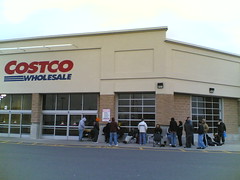
Buy in bulk. It may not sound environmentalist at first, but it is in so many ways. Imagine only going to the market once every month, your food never spoiling. How much would you save on gas? On packaging, from buying big containers rather than small? Now that situation is exaggerated, but many non-perishable items can be bought in bulk, saving considerable amounts of energy, like soda, vegetable oils, cereals, soap, shampoo, ink, paper, water (unless you've switched to tap like a good treehugger!) and more. Sooner or later you'll use all of whichever one of those items you have so there's no reason not to stock up. It's not necessary to fill a minivan with groceries as if your basement is about to serve as a nuclear bunker for three years for everyone on your block, but why make three trips on three separate days to the market to get 12-packs of soda when you can make one trip to the Coscto and get one big 36-pack? If you don't follow this tip for the environmental effect, at least do it because it's so convenient!

13 August, 2009

230 MPG? Not really.


So maybe you've heard of the new Chevy Volt. They're saying it gets 230 miles to the gallon of gasoline. There's just one little problem with that calculation: it applies to when the car is running only on electricity and not gasoline. The way a hybrid car works is that it runs on electricity and, when it runs out, it runs on gasoline. So if you're only driving for, say, 10 miles at a time, charging the car up completely each time, you are getting mileage like that! If you want to drive 100 miles in one go, you're out of luck. When the Chevy Volt is out of electricity and is running on gasoline, it gets only 50 miles to the gallon. Now don't get us wrong, that is AWESOME, but it's not 230 MPG. So don't expect to be able to drive cross-country with the Volt on one charge and full tank without doing at least some environmental damage. The Volt is still an excellent jump forward for the American clean car industry and great news for the environmentalist movement (and it looks so freaking cool too!)

08 August, 2009

Eco-Tip 20


Every week we'll post another easy tip to help you be environmentally friendly.

Eco-Tip 20
Eat less meat. Bear with me, I'm not going to get preachy! The meat industry is shockingly energy intensive, all morality aside. Rather than deliver the raw, wholesome and complete nutrients straight to the consumer, the meat industry redirects it through a new medium and ends up sacrificing most of the plants' calories, protein, vitamins and minerals, all while using more unnecessary energy to transport livestock, feed and to run slaughterhouses. I won't bombard you with statistics; instead I'll just give you this link. It's not necessary to immediately abandon all meat products and by-products. It's understandable: many cultures cook a lot of meat and it can be an arduous process to switch off. Any level of limiting meat consumption goes a long way.

P.S. Sorry there was no post last week. I was in San Jose with no internet. (I barely survived.)
P.P.S. Cash for Clunkers is AWESOME!