Happy holidays everyone!
23 December, 2009

20 December, 2009
The Story of Cap & Trade...
An interesting and unique take on one of the more plans to control carbon emissions:
19 December, 2009
Eco-Tip 38

Every week we'll post another easy tip to help you be environmentally friendly.
Eco-Tip 38
Wrapping paper. It's hard to fold, it's heavy, it's overpriced and it's not very environmentally friendly. Sure, there is wrapping paper out there made of recycled paper, but it's hard to find and still pretty energy intensive for something that's going to get torn up and thrown away. Solution? Try wrapping your gifts in old newspaper. It won't look so pretty -- in fact it will probably look downright strange, but it serves its purposes: to hide whatever the gift is and to give the receiver something to viciously tear apart.
13 December, 2009
The "Climategate" Scandal
Recently the University of East Anglia, which investigates climate change, had thousands of emails leaked, supposedly disproving the existence of global warming. Here's the nation's most reliable news reporter discussing it:
| The Daily Show With Jon Stewart | Mon - Thurs 11p / 10c | |||
| Scientists Hide Global Warming Data | ||||
| ||||
12 December, 2009
Eco-Tip 37

Every week we'll post another easy tip to help you be environmentally friendly.
Eco-Tip 37
If you need an ice pack, instead of buying one from the market, just freeze water in a water bottle. You should be avoiding bottled water when possible to begin with (it is less strictly regulated by the FDA than tap water is by the EPA) but we all know that, sometimes, it's a necessary evil. So when you do have a water bottle, instead of recycling it immediately, try bringing it home, filling it with tap water and freezing it to use as an ice pack for lunch boxes and whatnot. If/when the plastic cracks or the bottle becomes unusable, just recycle it like you normally would! It's all about making the most of what you buy.
05 December, 2009
Eco-Tip 36
Every week we'll post another easy tip to help you be environmentally friendly.
Eco-Tip 36
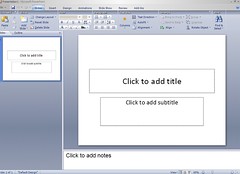
DO NOT print slides on powerpoint! Very rarely should you ever feel compelled to print powerpoint slides as one slide per sheet of paper. Most people don't even mean to -- they just print without thinking about it. Make sure you make a habit of printing handouts NOT slides! And if you accidentally do print slides, cancel the printing job ASAP! I made this mistake early Friday morning and I managed to cancel the job with only one sheet printed. One sheet too many. Don't make this mistake!
28 November, 2009
Eco-Tip 35

Every week we'll post another easy tip to help you be environmentally friendly.
Eco-Tip 35
Follow magazines and newspapers on the internet rather than with a paper subscription. A big crisis of the newspaper and magazine industry is the increasing proliferation of publications on the internet, and it may be for the greater good: reading articles on the internet, obviously, creates no paper waste. (Yes, it does naturally create waste through energy used, but it is comparable to the energy wasted in delivering the paper or magazine). You may feel guilty about not giving any money to the publication that you so enjoy, but many offer online subscriptions that have more benefits (the New York Times, for example, has an online subscription option that lets you view older articles rather than just recent ones -- that'd be pretty tough with a stack of newspapers!)
21 November, 2009
Eco-Tip 34

Every week we'll post another easy tip to help you be environmentally friendly.
Eco-Tip 34
There are two bits of advice to follow regarding batteries: firstly, avoid them, and secondly, when you can't avoid them, recycle them. Batteries contain heavy metals that are very toxic to the environment, and although many battery-making companies are cutting down on the amount of heavy metals in them (especially mercury), they are still not safe to dispose of in an ordinary trash can. If you need to dispose of batteries, you need to recycle them -- no NOT in your recycling bin! There are a number of stores around the country that will collect and properly dispose of your batteries without harming the earth (and you don't even need to travel far!) Just look here: http://www.call2recycle.org/home.php?c=1&w=1&r=Y (upper-right corner, enter your zip code). Never toss out a battery!
20 November, 2009
Why cars may be greener than buses!
BBC's "Ethical Man" makes an interesting case as to why cars may be more efficient than buses and trains. It's very interesting, so I wanted to share it. Don't be so eager to start driving though! Towards the conclusion he writes:
"Even though travelling by car can be less polluting than public transport you should always take the public transport option.
That's because buses and trains are running anyway. They will be out there generating CO2 whether you ride them or not. So when you choose to take your car, the pollution you create will be on top of whatever the public transport option is producing."
Here's the full article: http://www.bbc.co.uk/blogs/ethicalman/2009/11/why_cars_are_greener_than_buses.html
14 November, 2009
Eco-Tip 33

Every week we'll post another easy tip to help you be environmentally friendly.
Eco-Tip 33
Quality or quantity? Here's another aspect to look for before making a purchase: durability. Now the durability of a product should be important to anybody, environmentally conscious or not, but it should be especially important to you just because you are environmentally conscious. If you buy something and it breaks, there are two paths: it gets recycled or otherwise dismantled so that the parts can be pieced together into something else (good) or it's simply thrown out to sit in a land fill for a couple thousand years (bad). Now although the former option is good, it still requires energy that would otherwise be unnecessary. The best thing to do is to plan ahead and make sure a product is durable enough to be worth the money and the environmental burden inherent in the materials and production.
07 November, 2009
Eco-Tip 32

Every week we'll post another easy tip to help you be environmentally friendly.
Eco-Tip 32
Now that it's getting cold, you should know about one thing you should NOT do to keep your house warm: do not use the fireplace. Unless your fireplace is EPA-certified, and it's probably not, you can lose somewhere between 70% and 90% of the fire's heat through the chimney. The EPA also estimates that some 75% of fireplaces release a lot of unnecessary pollution. On the other hand, if you do modernize your fireplace to meet EPA guidelines, you will not only keep your house warmer with it but will also receive a tax credit for it. Until that day, just watch that burning Yuletide log channel on TV.For more information from the New York Times article that inspired this post, click here.
31 October, 2009
Eco-Tip 31

Eco-Tip 31
Happy Halloween! Halloween can be a drag for Mother Nature with all those candy wrappers and disposable Halloween decorations, but here are a few tips to keep yours fun and responsible at the same time:- Cut up some cardboard boxes to make cheap tombstones. What better way to mourn the strange string of celebrity deaths this summer?
- Try to buy candy with minimal packaging. Generally the obscenely mass-produced candies have pretty little packaging to save companies money.
- Collect your candy in a pillow-case. You don't need to buy anything or throw anything away... although you may just want to wash it when it reeks of Skittles and whatnot.
- WALK to trick-or-treat! You get exercise, you save carbon emissions and you can probably even get miles for fitness class!
- If you did buy a Halloween decoration or trick-or-treating necessity, re-use it every year. If you can't re-use it, don't buy it again. The only reasonable source of garbage on Halloween ought to be candy wrappers.
24 October, 2009
Happy Climate Action Day!

Today is Climate Action Day, an annual event when climate activists around the world demonstrate, calling for the levels of carbon dioxide in the air to be cut to 350 parts per million (as opposed to 390 parts per million -- the level that it is at now).
For more information, visit http://www.350.org/
Here are some more interesting images of demonstrations around the world: http://news.bbc.co.uk/2/hi/in_pictures/8323954.stm
Eco-Tip 30
Every week we'll post another easy tip to help you be environmentally friendly.
Eco-Tip 30
Instead of the usual weekly tip, I'm switching it up. Here's a very enlightening video on easy ways to save water!Cutting down on meat consumption also saves a lot of water. For years, every single animal needs a substantial amount of water before getting to your plate (and the plant-based feed it eats also needs a substantial amount of water). Where does that water go? Is it really worth it?
17 October, 2009
Eco-Tip 29

Every week we'll post another easy tip to help you be environmentally friendly.
Eco-Tip 29
Be on the look-out for random eco-friendly products. I stress here that it is not necessary (and probably not possible) to go utterly carbon neutral overnight, buy only recycled materials, buy only local organic food, etc. However, if you see a new cereal at the market that's packaged in a box made of recycled fiber, for instance, go buy it., especially if your usual cereal doesn't come in that sort of box. The purpose of this is not to deprive yourself of what you like so you can save the environment; rather, think of the long term effects: eventually, companies will see that to stay on the market, they need some way to make themselves look genuinely green (that's why you need to make sure it's really genuine! Do not fall for any phony gimmicks!) to keep customers buying. Take Apple for instance: they've turned their hyper-thin computer style to advertise that they use less packaging and they use primarily non-toxic chemicals in their computers. That's certainly a reason why Microsoft is losing its control of the technological market. The government gives people tax breaks for using solar panels or driving hybrid cars as a push for the buyer to buy green products and for the producers to produce green products. You can do that perfectly well without the government!
10 October, 2009
Eco-Tip 28
Every week we'll post another easy tip to help you be environmentally friendly.
Eco-Tip 28
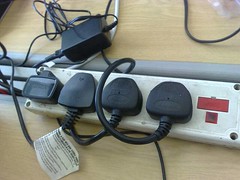
Unplug stuff. When you leave most things plugged in while they're turned off, you still use energy. Electricity companies call them "energy vampires" because they suck up electricity even when they're not really "alive." If you're too lazy to unplug everything (and most of us human beings are), plug most of your stuff into a power strip and turn it off when it's not in use.09 October, 2009
03 October, 2009
Eco-Tip 27

Every week we'll post another easy tip to help you be environmentally friendly.
Eco-Tip 27
It's getting colder, and that means dressing warmly, and not just when you're going outside anymore. Dressing a little more warmly inside -- maybe with a sweater, a light jacket, socks or even a snuggie (image, above) if that tickles your fancy -- means you can be more comfortable without having to jack up the thermostat. No, you should not wear a massive skiing jacket that makes you look like the Michelin man inside, and yes, you should still use your thermostat to keep your house warm, but 67 degrees or so is sufficient. You shouldn't have to change the thermostat frequently because it's cold inside for a short amount of time -- just put on another layer and the furnace will take care of it in time.
26 September, 2009
Eco-Tip 26

Every week we'll post another easy tip to help you be environmentally friendly.
Eco-Tip 26
Have Sharpie markers available for plastic cups the next time you have a party. If you're throwing a party, you don't want people drinking out of your family's fine Macy's glass set because you know while they're playing Guitar Hero at 11:30 PM, someone is bound to forget their Sprite is precariously on the arm of the couch and smash it all over the floor. At the same time, however, you don't want them using your not-so-fancy red cups because people would rather throw out their cup and get a new one every time they want a drink than remember which is theirs. The solution is to have a Sharpie by the cups and some obvious sign telling everyone to write their name on the cup once they take it. You will save money and the environment at the same time (have you noticed they tend to go hand-in-hand?)!And a big happy birthday to Dina Kapengut!!
19 September, 2009
Eco-Tip 25

Every week we'll post another easy tip to help you be environmentally friendly.
Eco-Tip 25
Shrink your margins. Have you ever been writing up homework or taking notes when you realize you go two or three lines into another page, meaning you'll need to waste another piece of paper? And you just can't trim the work so it fits on one fewer sheet? Well unless the work is an MLA-style essay, try shrinking the margins. In Word, click "Page Layout," choose "Margins" and switch the margins to "narrow" or .5 inches on each side. It is almost guaranteed to work every time. Every little bit counts!
13 September, 2009
05 September, 2009
Eco-Tip 24

Every week we'll post another easy tip to help you be environmentally friendly.
Eco-Tip 24
If you can't print on both sides of a piece of paper, or if you have a sheet that is only printed on one side, don't recycle it so quickly. Fold the paper over horizontally and vertically and cut it into quarters. Use these to jot down phone numbers or do short scratch work for a math problem or just to serve as an aid for your sudoku puzzle. You don't need to feel guilty because it's all going in the recycling in the end (because you will recycle it, of course!) Once the school year starts and you make a habit of this, you will never ever run out of scratch paper... unless you have a serious sudoku addiction.
29 August, 2009
Eco-Tip 23

Every week we'll post another easy tip to help you be environmentally friendly.
Eco-Tip 23
Don't worry about flying. Whether you're flying on a commercial plane or not, it's going to fly. It may sound cynical, but the need to travel by plane will never end. Ever. There are too many businesspeople, too many family reunions, too many vacations to end air travel. Ecology should not be an issue when choosing whether or not to fly unless somehow you've found an airline with extraordinarly energy efficient planes which, to my knowledge, doesn't exist yet. So guiltlessly travel all you want -- just don't get a private jet.22 August, 2009
Eco-Tip 22

Every week we'll post another easy tip to help you be environmentally friendly.
Eco-Tip 22
Be wary of sustainable products. Yes, buying a t-shirt made of recycled bottles is great. Buying fabric grocery bags instead of using and tossing paper or plastic bags is excellent. But just because something is sustainable doesn't mean you should buy it. Even if the shirt you're wearing isn't made with organic cotton and isn't dyed with, oh, I don't know, locally grown organic plum extract, what's important is that you've bought it and if you've bought it, you'd better make the best of it. It'd be wonderful to have an ever expanding walk-in closet filled with 110% sustainable clothing, but it's even better to simply own the clothes you need and make smart choices when you have to buy. All the gratuitous articles in your wardrobe just mean unnecessary production and transportation. If you've already bought a piece of clothing or used a plastic grocery bag, use it to the best of its ability. Wear the shirt until it's torn and then use it as a cleaning rag; use the plastic bag to line your trash bins or carry food. It's not like a Hummer where you melt more of the ice caps every time you start the car.15 August, 2009
Eco-Tip 21
Every week we'll post another easy tip to help you be environmentally friendly.
Eco-Tip 21
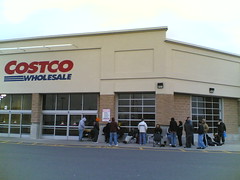
Buy in bulk. It may not sound environmentalist at first, but it is in so many ways. Imagine only going to the market once every month, your food never spoiling. How much would you save on gas? On packaging, from buying big containers rather than small? Now that situation is exaggerated, but many non-perishable items can be bought in bulk, saving considerable amounts of energy, like soda, vegetable oils, cereals, soap, shampoo, ink, paper, water (unless you've switched to tap like a good treehugger!) and more. Sooner or later you'll use all of whichever one of those items you have so there's no reason not to stock up. It's not necessary to fill a minivan with groceries as if your basement is about to serve as a nuclear bunker for three years for everyone on your block, but why make three trips on three separate days to the market to get 12-packs of soda when you can make one trip to the Coscto and get one big 36-pack? If you don't follow this tip for the environmental effect, at least do it because it's so convenient!
13 August, 2009
230 MPG? Not really.

So maybe you've heard of the new Chevy Volt. They're saying it gets 230 miles to the gallon of gasoline. There's just one little problem with that calculation: it applies to when the car is running only on electricity and not gasoline. The way a hybrid car works is that it runs on electricity and, when it runs out, it runs on gasoline. So if you're only driving for, say, 10 miles at a time, charging the car up completely each time, you are getting mileage like that! If you want to drive 100 miles in one go, you're out of luck. When the Chevy Volt is out of electricity and is running on gasoline, it gets only 50 miles to the gallon. Now don't get us wrong, that is AWESOME, but it's not 230 MPG. So don't expect to be able to drive cross-country with the Volt on one charge and full tank without doing at least some environmental damage. The Volt is still an excellent jump forward for the American clean car industry and great news for the environmentalist movement (and it looks so freaking cool too!)
08 August, 2009
Eco-Tip 20

Every week we'll post another easy tip to help you be environmentally friendly.
Eco-Tip 20
Eat less meat. Bear with me, I'm not going to get preachy! The meat industry is shockingly energy intensive, all morality aside. Rather than deliver the raw, wholesome and complete nutrients straight to the consumer, the meat industry redirects it through a new medium and ends up sacrificing most of the plants' calories, protein, vitamins and minerals, all while using more unnecessary energy to transport livestock, feed and to run slaughterhouses. I won't bombard you with statistics; instead I'll just give you this link. It's not necessary to immediately abandon all meat products and by-products. It's understandable: many cultures cook a lot of meat and it can be an arduous process to switch off. Any level of limiting meat consumption goes a long way.
P.S. Sorry there was no post last week. I was in San Jose with no internet. (I barely survived.)
P.P.S. Cash for Clunkers is AWESOME!
P.S. Sorry there was no post last week. I was in San Jose with no internet. (I barely survived.)
P.P.S. Cash for Clunkers is AWESOME!
28 July, 2009
25 July, 2009
Eco-Tip 19

Every week we'll post another easy tip to help you be environmentally friendly.
Eco-Tip 19
Buy organic, but only when it makes sense. Yes, it is better to buy organic, but it isn't that simple. Sometimes organic foods can travel so far from farm to market that the positive aspects of being organic are entirely negated. There's no clear line or balance to dictate when it's better to buy more locally or organically, but you can generally judge on a case-by-case basis without too much trouble. Organic peaches from New Zealand or inorganic peaches from Delaware? Inorganic from Delaware. Organic apples from Pennsylvania or inorganic apples from New York? Organic from Pennsylvania. It often is really just that easy. And it's understandable if buying organic isn't in your fiscal reach, especially in these unideal economic times. There are a slew of other ways you can help the environment that also save money!
18 July, 2009
Eco-Tip 18

Every week we'll post another easy tip to help you be environmentally friendly.
Eco-Tip 18
Buy local WATER. What are we talking about? Lots of brands of water from all over the world are holding ground in American markets -- some even posing as environmentally conscious products. Don't trust them. We've got nothing against globalization, but seriously, there's no reason to buy water from hot springs from some nearly uninhabited island in the middle of the Pacific Ocean or from glaciers on French mountain tops. Water is water, H2O, there's no reason it can't be from a water fountain or even Poland Spring if you must. I was reminded of this issue the other day at big event where the only beverages available were sodas and Fiji (both ridiculously overpriced since everyone was desperate.) I went with a soda because even if it is made from tap water and dozens of esoteric chemicals in a factory on some NJ highway, it sure didn't travel that far.
And of course I recycled the bottle after I was finished.
And of course I recycled the bottle after I was finished.
11 July, 2009
Eco-Tip 17

Every week we'll post another easy tip to help you be environmentally friendly.
Eco-Tip 17
Get a water filter. There is no excuse today to still be living off of bottled water for home, even bulk packages. You get the same water at the same quality with just your tap water and a purifier (in most cases the filter isn't even necessary.) It's a little-known fact that tap water and bottled water are actually reviewed by two separate government agencies: the EPA (Environmental Protection Agency) and FDA (Food & Drug Administration), respectively. This is important because the EPA has higher standards than the FDA, which means tap water is really safer to drink in most cases. There's still a paranoia surrounding tap and it's not totally baseless -- bottled water doesn't travel through miles of old rusting pipes. That's what the water filter is for. You just put the water in the dispenser and it takes out all nasty particles automatically. Oh, and it saves a LOT of money. Try a big, trusted brand like Brita.
04 July, 2009
Happy Fourth of July!

Happy Fourth of July everybody! No eco-tip today. Go to a picnic, take a nap and enjoy some fireworks.
27 June, 2009
Eco-Tip 16

Every week we'll post another easy tip to help you be environmentally friendly.
Eco-Tip 16
Buy locally and buy seasonally. Anytime you (or your parents) are shopping at the supermarket, check to see where the produce came from . It's not always going to be possible to find wholesome, organic food grown right across the street but a good rule of thumb is to try to buy food grown both in the United States and in this time zone. Along with this advice comes the importance of buying seasonally. You're not going to find a lot of locally grown squash this time of year because it's a winter crop, so opt for tomatoes and other summer vegetables; in the winter, rather than buying plums grown in Argentina, opt for some Northeastern apples or oranges. This produce should also be fresher because the time between when it is picked and when it's eaten is much shorter.
20 June, 2009
Eco-Tip 15
Every week we'll post another easy tip to help you be environmentally friendly.
Eco-Tip 15
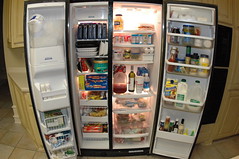
Keep the fridge full, but not too full. Food retains cold better than air so a fridge full of food uses less energy than an empty one. There's a catch though: don't fill it up too much. There still has to be enough room for air to circulate. You really need to eyeball it and see if you can find that sweet spot where it's not empty but not totally packed. What if you don't have enough food to keep it full? Buy lots of water (preferably in jugs rather than bottles since they use less plastic per unit volume) and keep them in the fridge.
14 June, 2009
13 June, 2009
Eco-Tip 14

Every week we'll post another easy tip to help you be environmentally friendly.
Eco-Tip 14
Do NOT buy your summer reading books! If you're being assigned a book to read for English over the summer, there is an overwhelmingly good chance that it's a classic, and if it's a classic, it's at your library. Be realistic, do you really think you will ever read the book again? Even if the answer is yes, you should still borrow the book first to assure you don't waste money (and paper) on a book that you hate. That's the idea of renting movies: don't waste as much money to own a movie you just might hate. The library provides that convenience without you having to pay anything (unless you return the book late.) Admittedly, some books simply do not exist at the library. I personally had to search a six-story bookstore in London before I could find a copy of Pedro Paramo. Don't feel too guilty in these cases... it is for academics, after all.
06 June, 2009
Eco-Tip 13

Every week we'll post another easy tip to help you be environmentally friendly.
Eco-Tip 13
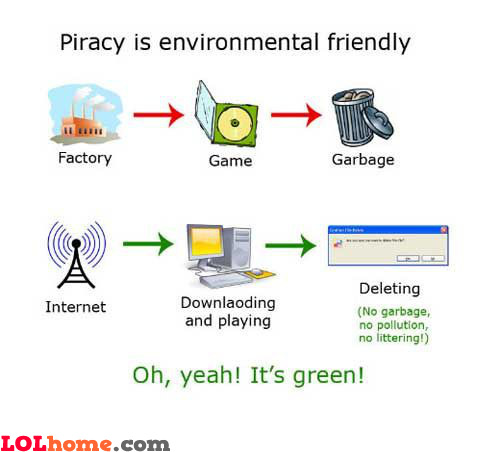
Download music online! No, this isn't some spam advertisement and we're not telling you to do anything illegal. We're saying use online stores like iTunes to purchase music rather than buying from a music store. Why? It creates less waste! You can buy all the music available on iTunes and still waste less material than buying one CD. And because online stores are available right in your own home, you save the carbon footprint of driving to the record store (unless you walk or bike, and if you do, bravo!) This is commerce of the future!
30 May, 2009
Eco-Tip 12

Every week we'll post another easy tip to help you be environmentally friendly.
Eco-Tip 12
Donate your books! If you own a plethora of books you would rather get rid of, don't recycle them and DON'T throw them out! Just about every library accepts book donations to put on their shelves or sell. This is not just a way to help the community but a way to help the environment. With a greater market for used books, fewer people will buy brand new books and less paper will be used, all without going through the energy-intensive step of recycling. The Reduce-Reuse-Recycle mantra is supposed to be followed in order: purchase and use less, reuse what you've already used and when you can use it no more, put it in the recycling (unless it's a battery, then recharge it.) And while you're at the library, check out their used book selection. Many are in perfect condition and sell for a very small fraction of the ordinary value, and all the money goes to the community.
23 May, 2009
Eco-Tip 11

Every week we'll post another easy tip to help you be environmentally friendly.
Eco-Tip 11
Obey, or at least try to stay around the speed limit! Speed limits were created not only to keep us safe but to maximize our cars mileage on a given road. We all know speed limits are a drag to follow and that although driving 25 may keep kids alive, it'll make everyone behind you wish you weren't, but they're there for a reason. Do your best to obey the speed limit whenever possible, even if it's only as a suggestion. Five or ten miles above (or below - if that ever happens) the limit won't hurt, in fact it will make you pay less at the pump and help save the environment.
20 May, 2009
Wolfram Alpha
In case you haven't heard of Wolfram Alpha, it is the coolest thing in the world. Here's an intro, in case you have not heard of it or do not know how to use it. You can input statistics and it will calculate information it finds useful to you. Why is the Environmental Committee posting it? Because has statistics on carbon emissions for different countries. Try inputting "Carbon emissions UK/US" and it will divide the carbon emissions of Great Britain by those of the United States. You will notice that the graph shows the ratio is getting smaller as time progresses meaning that the UK's carbon emissions are decreasing and/or those of the US are increasing (both are true.) You can try this for a few other countries like Japan, France, Germany, Spain, Russia and more (unfortunately the People's Republic of China does not publicly release their statistics on a regular basis.) You should find the results interesting...
16 May, 2009
Eco-Tip 10

Every week we'll post another easy tip to help you be environmentally friendly.
Eco-Tip 10
If you are on a computer with a cathode ray tube monitor, firstly, you should switch to an liquid crystal display. CRTs emit hazardous electromagnetic radiation, they are laced with toxic chemicals, they use too much energy and can even implode and cause seizures. If you cannot get rid of your CRT, at least use Blackle to save energy. Blackle is essentially the same as Google except black since CRT energy usage depends on the shade of color displayed (white is highest, black is lowest.) As for the radiation and implosions and seizures, you're on your own.
09 May, 2009
Eco-Tip 9

Every week we'll post another easy tip to help you be environmentally friendly.
Eco-Tip 9
Although the supply of water may seem unlimited to people as fortunate as us, always remember that clean water is a very scarce resource in the world as a whole. Here are a few ways to minimize your water usage: use the water only to rinse your toothbrush, do not have it running while you brush; fill the sink basin with water to rinse your razor when you shave, rather than have it running all the while; and try taking shorter (or at least not longer) showers, if you want to take a really extended shower, just take a bath.
02 May, 2009
Poll!
So I know, the last poll was pretty bad. I'm out of ideas for surveys, so I'm going to use another community forming aspect of this blog to help get a new, better survey up soon. Just leave a comment below - you don't even need a Google account, you can leave it anonymous or not. Just leave a question you want to see on the side and possible answers. Thank you!
Eco-Tip 8
Every week we'll post another easy tip to help you be environmentally friendly.
Eco-Tip 8
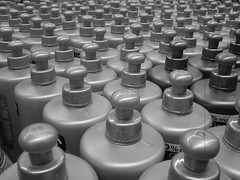
Summer is (finally) coming up and, if you plan on going on vacation, you will probably be staying in a hotel. Well, you know those little shampoo and conditioner bottles they have in the shower? Although they smell great, resist using them. Why? Because containing such a small amount of shampoo in a plastic bottle is very wasteful. Imagine splitting up a big bottle of shampoo into ten smaller bottles. Where is there more plastic - the single big bottle or the all the smaller bottles? It doesn't make sense to toss another plastic bottle every day you stay at a hotel when you could just carry along your home shampoo bottle.
28 April, 2009
Next Meeting

Then next meeting is Thursday, 5th period in the health room. We will be discussing the Reuse-a-Shoe project.
25 April, 2009
Eco-Tip 7

Every week we'll post another easy tip to help you be environmentally friendly.
Eco-Tip 7
Now that it's Spring and the sun has come out, there's a better way to do the laundry: instead of putting your clothes in the dryer, just run a string between two trees in your backyard or across a balcony and hang up your clothes. It's so easy and it saves a ton of energy. Just make sure to check the weather first - you don't want your clothes outside in torrential rain or hurricane-force winds!
22 April, 2009
Happy Earth Day!

Use today to reflect on how "green" your everyday habits are and see if you can reduce your effect on the environment even more.
18 April, 2009
Eco-Tip 6

Every week we'll post another easy tip to help you be environmentally friendly.
Eco-Tip 6
The environmentally safe method to fix a slow drain: dump a half cup of baking soda down the drain then pour in a half cup of white vinegar. Wait for twenty to thirty minutes, then pour down about a half gallon of boiling water. It's safer than toxic drain cleaners and cheaper than calling a plumber. Good job - now your cats can enjoy the comfort of a sink without the water.
Source: It's Easy Being Green by Crissy Trask
15 April, 2009
Happy Tax Day!
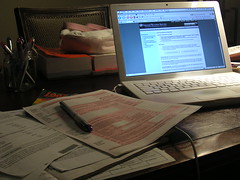
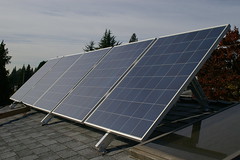
Yet another reminder to your parents of all the money they could have saved if only they installed solar panels!
12 April, 2009
11 April, 2009
Eco-Tip 5

Every week we'll post another easy tip to help you be environmentally friendly.
Eco-Tip 5
Use your microwave. Heating food in the microwave is faster and much more efficient than using a stove or oven. Think about it: an oven must heat up all the air inside the oven - and keep it hot - to cook for food; a stove releases heat onto a pan or pot or whatnot, but it loses a significant amount of energy into the air. Microwaves (which you should remember from the electromagnetic spectrum in Foundations of Science!) heat the water inside the food and nothing else, cooking from the inside rather than the outside, making it much faster and more efficient. Why boil excess water in a kettle when you can get perfect cuppa tea or instant coffee from the microwave in two minutes? It is not recommended to experiment with what will and will not explode, catch fire etc in the microwave as this can destroy your microwave and possibly your home which is very wasteful.
09 April, 2009
REUSE A SHOE!

08 April, 2009

07 April, 2009

04 April, 2009
Eco-Tip 4

Every week we'll post another easy tip to help you be environmentally friendly.
Eco-Tip 4
This is the easiest green tip you'll ever have: close the shower curtain. It sounds silly, but when you close the shower curtain, it's easier for water to evaporate, thus preventing mold growth. Less mold growth means you don't have to replace the shower curtain as often. You'd be surprised how effective it is!
01 April, 2009
The Poll
Thank you everyone who voted in the poll! 100% have voted that they prefer meetings on A Days and 75% prefer them during 5th period. So henceforth we shall have all meetings afterschool (April Fools'! Just kidding!)
If the Environmental Committee gets more funding, we could embark on even more ambitious and exciting projects - providing the money for the school to purchase 100% recycled paper, replacing broken printers with new printers that can print on both sides or even install solar panels on the roof. They're all very high goals, but with the help of the Obama administration which promotes environmental reform, they might just be attainable. It may take years, but it just might happen. How do you feel about these aspirations for our committee? Tell us in the new poll!
Try to vote in every poll - it only takes a second and each is up for a month. Your vote is your voice in the committee.
If the Environmental Committee gets more funding, we could embark on even more ambitious and exciting projects - providing the money for the school to purchase 100% recycled paper, replacing broken printers with new printers that can print on both sides or even install solar panels on the roof. They're all very high goals, but with the help of the Obama administration which promotes environmental reform, they might just be attainable. It may take years, but it just might happen. How do you feel about these aspirations for our committee? Tell us in the new poll!
Try to vote in every poll - it only takes a second and each is up for a month. Your vote is your voice in the committee.
31 March, 2009
Happy Birthday!
Happy birthday to Al Gore!
Gore served as vice president under Bill Clinton for eight years then ran for president in 2000. He won the majority of votes, but not the majority of electoral votes, leading to the presidency of George W. Bush, one of the most turbulent and controversial two-term presidencies in American history. In 2006, half-way through Bush's second term, he went on to create An Inconvenient Truth, the catalyst of the environmental movement in the 21st century. Republican or Democrat, love him or hate him, you've got to admit, he is the father of modern environmentalism. Happy birthday!

Subscribe to:
Comments (Atom)